
Finding Bottlenecks Before They Become Delays
In software development, delays rarely appear without warning. A missed deadline, an unstable release, or a project that suddenly falls behind often begins with smaller signals that were visible weeks earlier. A growing pull request backlog, increasing review times, repeated build failures, or a growing dependency queue may all indicate that a workflow problem is developing.
The challenge for engineering leaders is identifying these signals early enough to take action.
Modern engineering organizations are using engineering analytics to detect bottlenecks before they become delivery problems. By analyzing how work moves through development processes, teams can uncover hidden constraints, improve predictability, and continuously optimize how software is delivered.
The goal is not to monitor individual performance. It is to understand the systems that support engineering teams and remove obstacles that slow down innovation.
Why Bottlenecks Are Difficult to Detect
Software delivery is a complex process involving many interconnected stages:
- Planning and prioritization
- Development
- Code review
- Testing
- Deployment
- Production monitoring
- Maintenance
A delay in one area often creates problems elsewhere.
For example, a slow review process may cause developers to work on fewer tasks. This creates longer delivery cycles, which can delay releases and impact business goals. By the time leadership notices the missed deadline, the original bottleneck may have existed for weeks.
Traditional reporting often focuses on outcomes after they happen:
- A project missed its target date.
- A release contained too many defects.
- A team struggled to complete planned work.
Engineering analytics allows organizations to move from reactive problem-solving to proactive improvement.
Understanding Workflow Bottlenecks
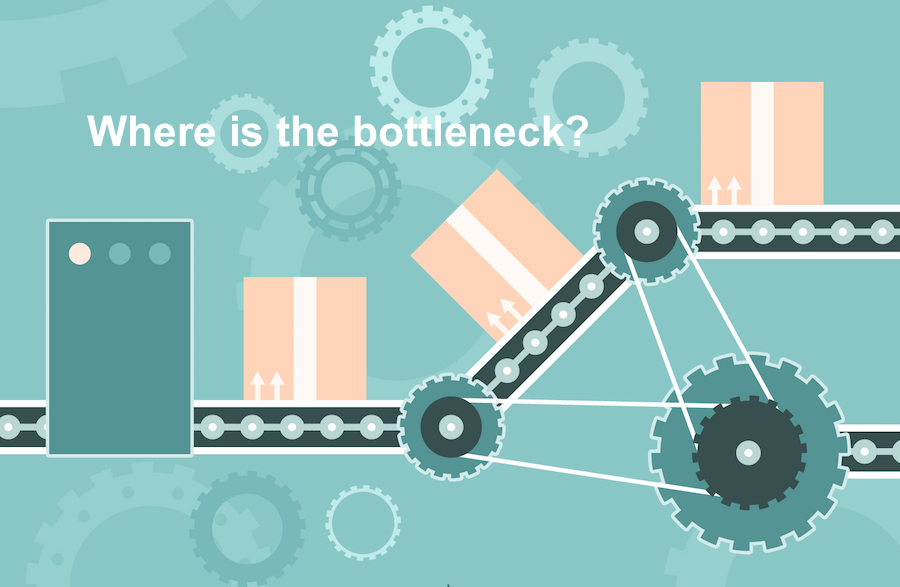
A bottleneck occurs when one part of a process limits the performance of the entire system.
In engineering organizations, common bottlenecks include:
- Slow code review cycles
- Manual approval processes
- Inefficient testing workflows
- Limited infrastructure capacity
- Unclear requirements
- Dependencies between teams
- Excessive technical complexity
These constraints often remain hidden because teams adapt around them. Developers may create workarounds, delay certain tasks, or spend time on manual activities without realizing how much impact they have on overall delivery.
Analytics helps reveal these patterns.
Measure the Flow of Work, Not Just the Output
A common mistake in engineering measurement is focusing only on completed tasks or delivered features.
While output matters, understanding how work moves through the system provides deeper insights.
Important workflow metrics include:
- Lead time
- Cycle time
- Work-in-progress levels
- Queue duration
- Review turnaround time
- Deployment frequency
- Release reliability
These measurements show where work spends time waiting, where processes slow down, and where improvements can create the greatest impact.
A team may appear productive because many tasks are completed, while hidden delays continue to reduce overall efficiency. Flow-based analytics helps expose those issues.
Identifying Code Review Bottlenecks
Code reviews are one of the most common sources of engineering delays.
A healthy review process improves quality and knowledge sharing, but slow reviews can create significant delivery friction.
Engineering analytics can highlight problems such as:
- Pull requests remaining open for extended periods
- Large changes requiring multiple review cycles
- Limited reviewer availability
- Reviews concentrated among a small number of engineers
Once these patterns are visible, teams can introduce improvements such as:
- Creating clearer review expectations
- Encouraging smaller pull requests
- Improving ownership distribution
- Automating routine checks
- Reducing unnecessary approval steps
The result is faster feedback without sacrificing software quality.
Detecting Testing and Deployment Constraints
Automated testing and deployment pipelines are designed to accelerate delivery, but they can become bottlenecks themselves.
Analytics can reveal:
- Increasing build times
- Frequent pipeline failures
- Slow integration tests
- Manual deployment steps
- Environment-related delays
For example, if a test pipeline takes 45 minutes and frequently fails, developers may avoid running tests locally or delay deployments. Over time, this creates additional risk and slows the entire organization.
Improving pipeline performance can have a direct impact on delivery speed and developer productivity.
Predicting Delivery Risks Earlier
One of the biggest advantages of engineering analytics is the ability to identify warning signs before they become major issues.
Potential risk indicators include:
- Increasing cycle times
- Growing unfinished work
- Declining deployment frequency
- Rising defect rates
- Higher numbers of blocked tasks
- Increasing dependency delays
When these patterns appear, leaders can investigate the underlying causes and take corrective action.
For example:
A project showing increasing cycle times may not need additional engineers. The actual issue could be unclear requirements, inefficient approvals, or a dependency on another team.
Analytics helps leaders address root causes rather than treating symptoms.
Improving Predictability Through Data
Predictable delivery is one of the most valuable outcomes of effective engineering analytics.
Organizations that understand their workflows can make more accurate forecasts because they have visibility into historical patterns.
Predictability improves when teams understand:
- How long different types of work typically take
- Where delays commonly occur
- How much work teams can realistically complete
- Which processes create uncertainty
This allows engineering leaders to set more realistic expectations with product teams, executives, and customers.
Predictability does not mean eliminating all uncertainty. It means reducing avoidable surprises.
Using Analytics to Guide Process Improvements
The most effective engineering organizations treat analytics as part of a continuous improvement cycle.
A typical approach looks like this:
- Measure current workflow performance.
- Identify recurring constraints.
- Prioritize the highest-impact bottleneck.
- Introduce a targeted improvement.
- Measure the results.
- Continue optimizing.
For example:
A team discovers that code reviews take an average of four days. They introduce smaller pull requests and clearer review ownership. After several weeks, analytics shows review time has dropped to one day.
The organization now has measurable evidence that the improvement worked.
Avoiding the Wrong Use of Engineering Analytics
While analytics can reveal valuable insights, the way metrics are used determines whether they improve or damage engineering culture.
Organizations should avoid using bottleneck analysis to:
- Rank individual developers
- Measure effort through activity counts
- Create pressure without addressing systemic issues
- Encourage teams to optimize metrics instead of outcomes
The purpose of analytics is to improve the environment where engineers work.
A delayed project is rarely caused by a single person. More often, it is the result of processes, tools, dependencies, or organizational structures that need improvement.
Building a Culture of Continuous Optimization
Finding bottlenecks is not a one-time activity. Engineering systems constantly change as teams grow, products evolve, and technologies shift.
A strong analytics culture encourages teams to regularly ask:
- Where is work slowing down?
- What creates unnecessary friction?
- Which improvements would have the greatest impact?
- Are changes producing better outcomes?
This mindset transforms engineering improvement from a reactive process into an ongoing discipline.
Teams become better at identifying problems early and adapting before small issues become major delivery challenges.
The Future of Predictable Software Delivery
Engineering analytics is changing how organizations manage software delivery. Instead of waiting for delays to appear, leaders can identify early warning signals and improve the systems that influence performance.
By analyzing workflow patterns, delivery metrics, quality indicators, and operational trends, engineering teams gain a clearer understanding of where bottlenecks exist and how to remove them.
The most successful organizations do not achieve predictable delivery by simply asking teams to work faster. They achieve it by creating better processes, improving tools, and using data to continuously optimize the way work flows.
Finding bottlenecks before they become delays is not just a productivity improvement—it is a strategic advantage that helps engineering organizations deliver higher-quality software with greater confidence and consistency.

